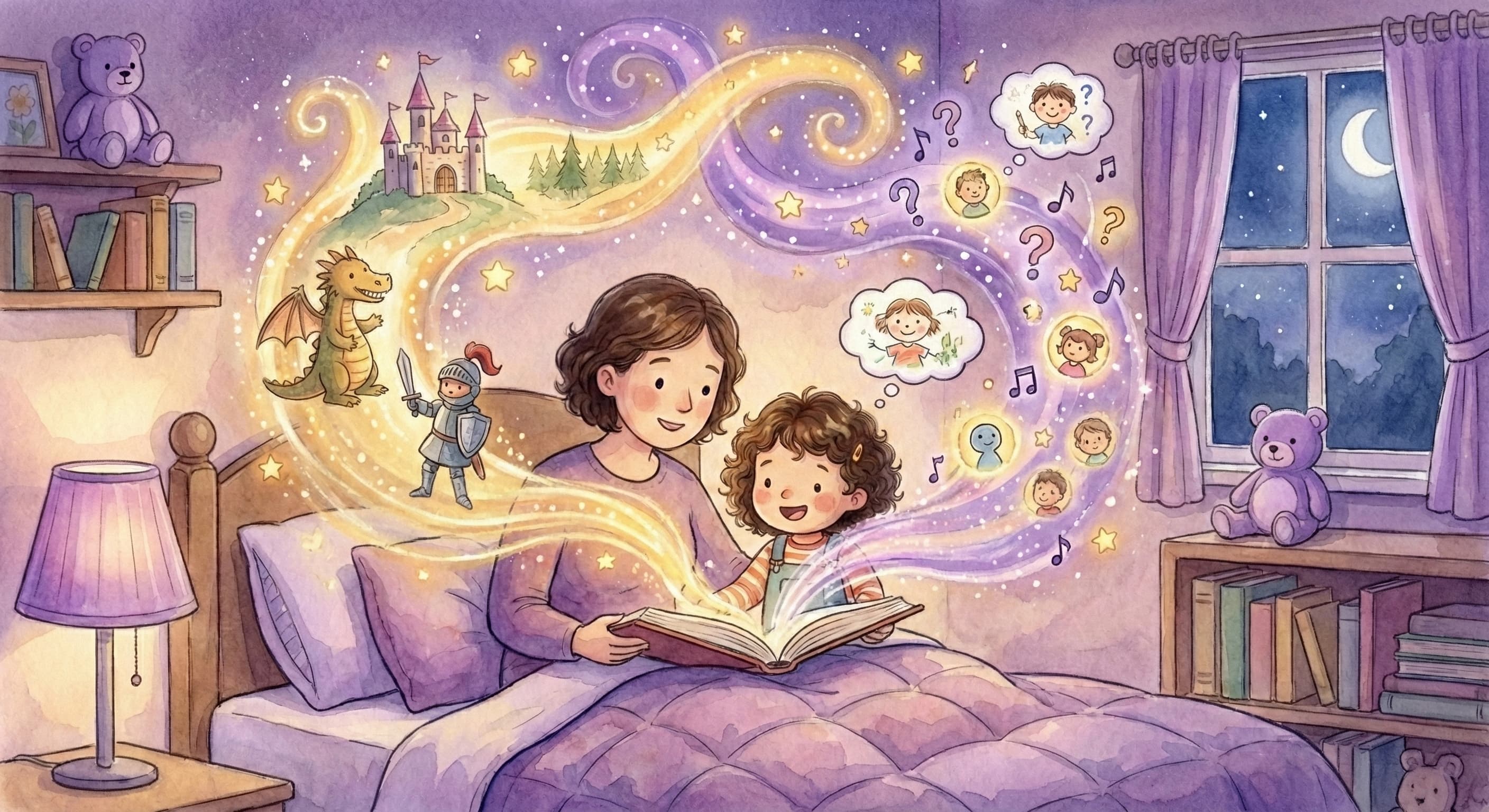
You might not think about it, but there are at least a few ways to read a bedtime story.
You have your favourite. You use it every evening. Without a second thought.
Different ways of asking questions during shared reading have become the subject of serious research among scientists studying language development in children. Based on an analysis of over 20 years of studies - conducted by Walsh and Hodge - one can sketch out a (rough) map:
Method One: The Quiz
"What colour is the frog?"
"How many birds are there?"
"What's the bear's name?"
These questions have One Correct Answer. They test whether your child was paying attention. Scientists call them low cognitive demand questions. (Not the most exciting name. Scientists are better at science than at catchy labels.)
Methods Two, Three, and Beyond:
"Why do you think the frog is sad?" [a so-called coherence question - designed to deepen understanding of the text];
"What do you think will happen next?" [can be a coherence question if we're looking for conclusions based on previous events - but it can also be a prediction question, one that steps outside the story entirely];
"How would you feel if that happened to you?" [a question using decontextualisation - transporting the story into another dimension, which might be the child's own experience].
These have No Single Correct Answer. They are an invitation for your child to step inside the story and look around.
Does that mean low cognitive demand questions are bad? Of course not. They're a wonderful foundation - the warm-up before the main event. They help build up a base of information that prepares a child for more demanding intellectual challenges.
More Demanding Intellectual Challenges
Children who regularly hear this second kind of question become, among other things, better at telling stories. Not just stories from books - but their own stories. The real ones. They develop stronger memory, a richer vocabulary for describing emotions, and a greater capacity for empathy.
Researchers from Pennsylvania State University go even further, examining the potential effects of dialogic reading not just on reading ability or vocabulary range, but on social competence and behaviour. Asking open questions isn't as easy as it sounds. So is it even worth it? When most school tests are built around questions with One Correct Answer... Well, yes. But school isn't the most important thing, is it?
This isn't just about learning to read - or even about giving the Right Answer. It's about feeling heard.
"Why is the dragon angry?" isn't (only) a comprehension check. It's also an exercise in empathy. And the dragon certainly doesn't mind being asked. (For an explanation of that particular phenomenon, see Article No. 1.)
You're Already Doing It
If you've ever paused halfway through a page and asked: "What do you think is going to happen?" - that's it. That's exactly it. You're using the full potential of reading, not just as a memory exercise, but expanding it - switching on the hidden features: imagination, building your child's sense that what they think is Important, an exchange of ideas, a search for meaning. In short: you're doing what Serious Scientific Research has been applauding for decades.
Tonight: start the way you always do - remembering it's a warm-up. A colour, a name, a number. Then shift into a higher gear with one nice, Small-and-Big Open Question. And listen carefully to the answer.
How Naniby Uses This
Most of the questions Naniby asks are open. As a warm-up, we might ask: "What colour is the castle?" But usually it sounds more like: "What do you think is hiding inside the castle?" The educational scaffolding is invisible. For your child, it's just a Great Time. But underneath - it's exactly what the best bedtime-reading parents do, following nothing but instinct.
Reviewed by Katarzyna Babka, MA, psychologist, specialist in child and adolescent psychotherapy
The Research
- Are we asking the right questions?
An analysis of research on the effect of teachers questioning on childrens language during shared book reading with young children. Journal of Early Childhood Literacy.
- Dialogic Reading’s Potential to Improve Children’s Emergent Literacy Skills and Behavior.
Preventing School Failure: Alternative Education for Children and Youth,