This might sound obvious. It isn't.
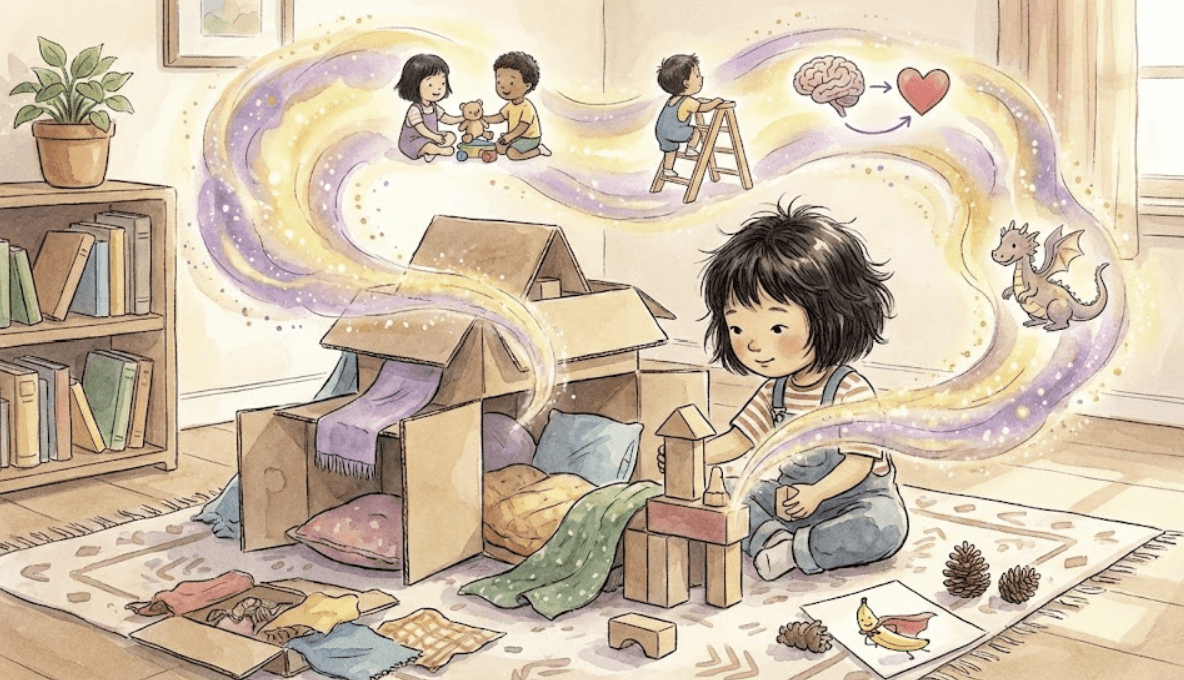
Play is not what children do instead of learning. Play is learning.
Not a supplement to learning. Not a warm-up before the real lesson. It is the single most fundamental, irreplaceable activity of childhood.
Wales (yes, that Wales) made headlines recently for its law banning politicians from lying - but it turns out that's not the only thing they're doing right: it was also the first country whose government took play seriously enough to introduce a "Play Policy" in 2002. Among other things, it placed a legal obligation on local councils to ensure children have adequate opportunities to play (!). Why?
What's happening inside
During the first five years of life, a child's brain builds new connections at a staggering rate - a process called synaptogenesis. And what powers it? You probably already know...
Play.
Unstructured, chaotic, child-led.
To give play the place it deserves in the adult imagination, it took a few(hundred) years and a few solid reports: the American Academy of Pediatrics (2007, updated in subsequent editions), the LEGO Foundation (2018), and UNICEF with IKEA (2015), among others. Their findings - and those of many others - agree: play is essential to cognitive, physical, social, and emotional development. Not just "helpful." Not "nice to have." Essential.
Not all play is the same (But all of it matters)
Developmental psychologists at the University of Cambridge - led by David Whitebread and the LEGO Foundation's research team — analysed findings from studies on different kinds of play and discovered that each builds something different:
- Physical play - Running, climbing, rolling. Builds motor skills, coordination, and body awareness. Also: joy (important).
- Social play - Playing with others. Teaches cooperation, empathy, negotiation, and the extremely important skill of losing without crying. (Some adults are still working on that one.)
- Play with objects - Exploring the world and the things found in it - first grabbing and chewing, then sorting, classifying, and building impressively complicated structures. Supports thinking, problem-solving, and representational skills (the floor is lava).
- Symbolic play - Language games (rhymes), making music, drawing, using symbols to create and communicate meaning. Develops communication.
- Pretend play - Fantasising. Imagining. Becoming someone else entirely. This is where creativity lives - but also social development, communication skills, and the ability to build a narrative.
- Games with rules - Board games, outdoor games (tag, hide-and-seek, geography games), digital games. Develops counting skills; many also have a strong social dimension - learning to share, wait your turn, and think strategically.
Play in the digital age
This is where it gets interesting. The LEGO Foundation report "Positive Play in the Digital Age", developed in collaboration with UNICEF and the RITEC consortium (Responsible Innovation in Technology for Children), maps out when digital play can actually be good for children:
- When it brings joy.
- When it engages (helps them focus, rather than scatter their attention).
- When it's meaningful to the child (connecting what happens in the game to their everyday life and experiences).
- When it's iterative (allowing for trial and error, and testing different ideas).
- When it's socially interactive (making it possible to share the experience with others).
When it's passive, the benefits disappear. The screen isn't the problem. Passivity is.
Every sandcastle, every imaginary friend, every "what if the floor is lava" - that's your child's brain doing Something Very Important.
Play is not a break from learning. It's how the brain learns best. Every sandcastle, every imaginary friend, every "what if the floor is lava" - that's your child's brain doing Something Very Important.
What you can do
Provide materials that are open-ended, undefined, and ready to be taken apart, repurposed, or combined into something else entirely. Blocks. Scraps of fabric. Cardboard boxes. Things with no instruction manual and no Single Correct Answer. Create space - physical and in the schedule - for play without a predetermined goal. And resist the voice in your head that says this is a waste of time.
How Naniby uses this
Naniby is built on the idea that the most powerful play is the kind that engages the imagination and is led by the child. Your child creates the hero, steers the plot, and decides what happens next. It's pretend play (and whatever else they fancy), with the AI following their lead. There are no correct answers. No pre-written endings. Just play that - as it happens - might also support how they grow.
Reviewed by Katarzyna Babka, MA, psychologist, specialist in child and adolescent psychotherapy.
The Research
- Convention on the Rights of the Child
United Nations
- The Power of Play: A Pediatric Role in Enhancing Development in Young Children
The Power of Play: A Pediatric Role in Enhancing Development in Young Children
- IKEA Play Report 2015
IKEA Play Report 2015
- Learning through Play : Increasing impact, Reducing inequality
Learning through Play : Increasing impact, Reducing inequality
- The Role of Play in Children’s Development
The Role of Play in Children’s Development
- Responsible Innovation in Technology for Children Digital technology, play and child well-being
Responsible Innovation in Technology for Children Digital technology, play and child well-being.