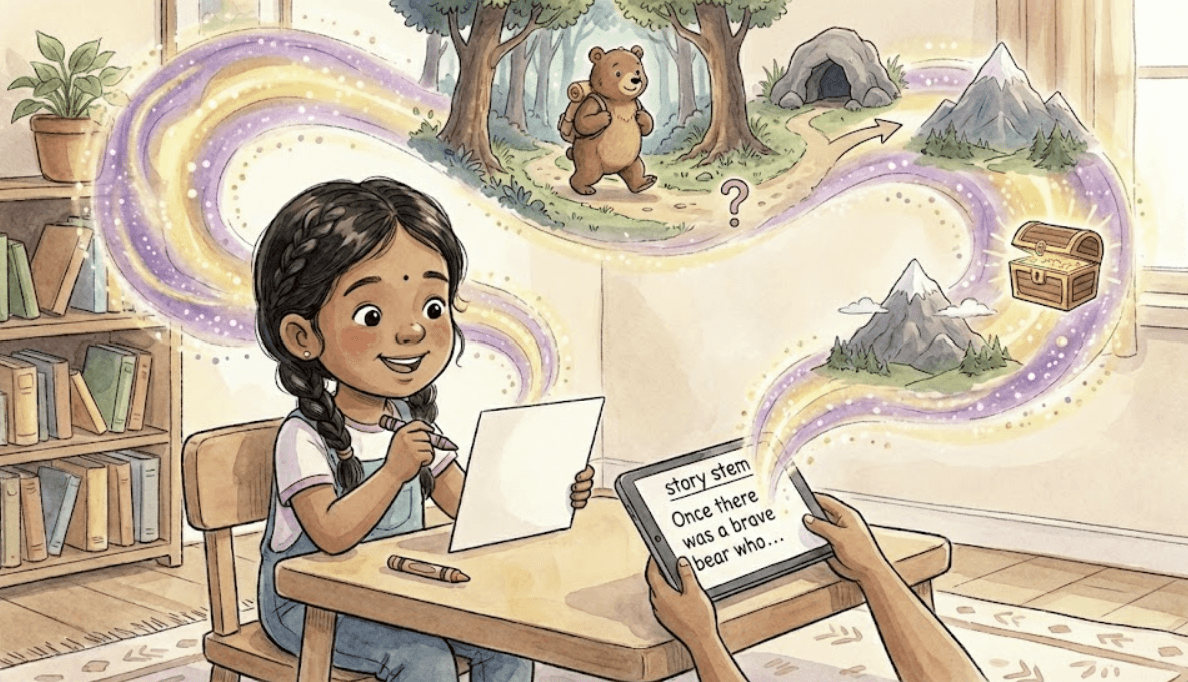
We'd like to share something we find genuinely fascinating.
Developmental psychologists have been circling this idea for decades - in one form or another - but the version that caught our attention dates back to the 1970s. It works on three-year-olds. It works on ten-year-olds. And most importantly, it lets us peek a little deeper: into the world of feelings, imaginings, and inner experiences that children carry around with them.
We're talking about narrative. About spinning stories, building worlds, the kind of free-wheeling "tale-making" that children do without being asked. It was in the 1970s that the Story Stems method emerged - more specifically, the MacArthur Story Stem Battery (MSSB) - a research and clinical technique built around presenting children with a set of unfinished stories and inviting them to complete them.
Why does it matter?
Studies using techniques like the MSSB provide real evidence for how pre-school children make sense of their experiences - and what actually matters to them emotionally.
Isn't that fascinating?
It is, to us. Simple and quietly extraordinary at the same time.
A child hears only the beginning of a story - a setup, a general sketch of the situation. A family at a birthday party. Juice spilled at the dinner table. A knock at the door. When the story reaches its turning point, the researcher stops. And invites the child to take over.
„What happens next?"
That's it. That's the story stem.
This is where the magic happens
Children don't just say anything. They pour their whole understanding of the world into the story.
How the character handles the spilled juice says something about how that child handles their own mistakes. Whether the friend at the door is greeted with joy or fear might say something about trust. Whether the conflict ends in forgiveness, in running away, or in a dragon eating the problem whole - that says something about how they carry their difficulties.
In that light, the question "What happens next?" reaches a lot further than "How are you feeling?" when you're asking a small child.
(This will surprise no one who has ever asked a four-year-old how they're doing. The answer is usually: "Purple.")
You're probably already doing this
Every time you pause mid-story and ask "What do you think happens next?" - you're working from exactly the same principle. A slightly different technique, the same magic. You don't need puppets (though honestly, why not?). You don't need a lab. You just need a little attention, and the awareness that some stories might mean more than they appear to.
Some of the stories parents have shared with us (the meanings of which we can only guess at) include: "The place where lost socks go to escape"; "A hospital for tired parents" (ouch); "A planet made of cake, but the cakes there are Very Bad."
How Naniby uses this
Whatever else you might say about it, Story Stems made a real impression on us. They inspired us - which is why we decided to use this thinking when shaping the structure of the stories created in Naniby. Drawing on what we know about child development, we deliberately and carefully build in a dilemma, a moment of choice, the point where it's the child who decides what kind of world this will be. The framework is decades old. But our banana is completely new.
Reviewed by Katarzyna Babka, MA, psychologist, specialist in child and adolescent psychotherapy.
The Research
- The MacArthur Story Stem Battery
Revealing the inner worlds of young children: The MacArthur Story Stem Battery and parent-child narratives.