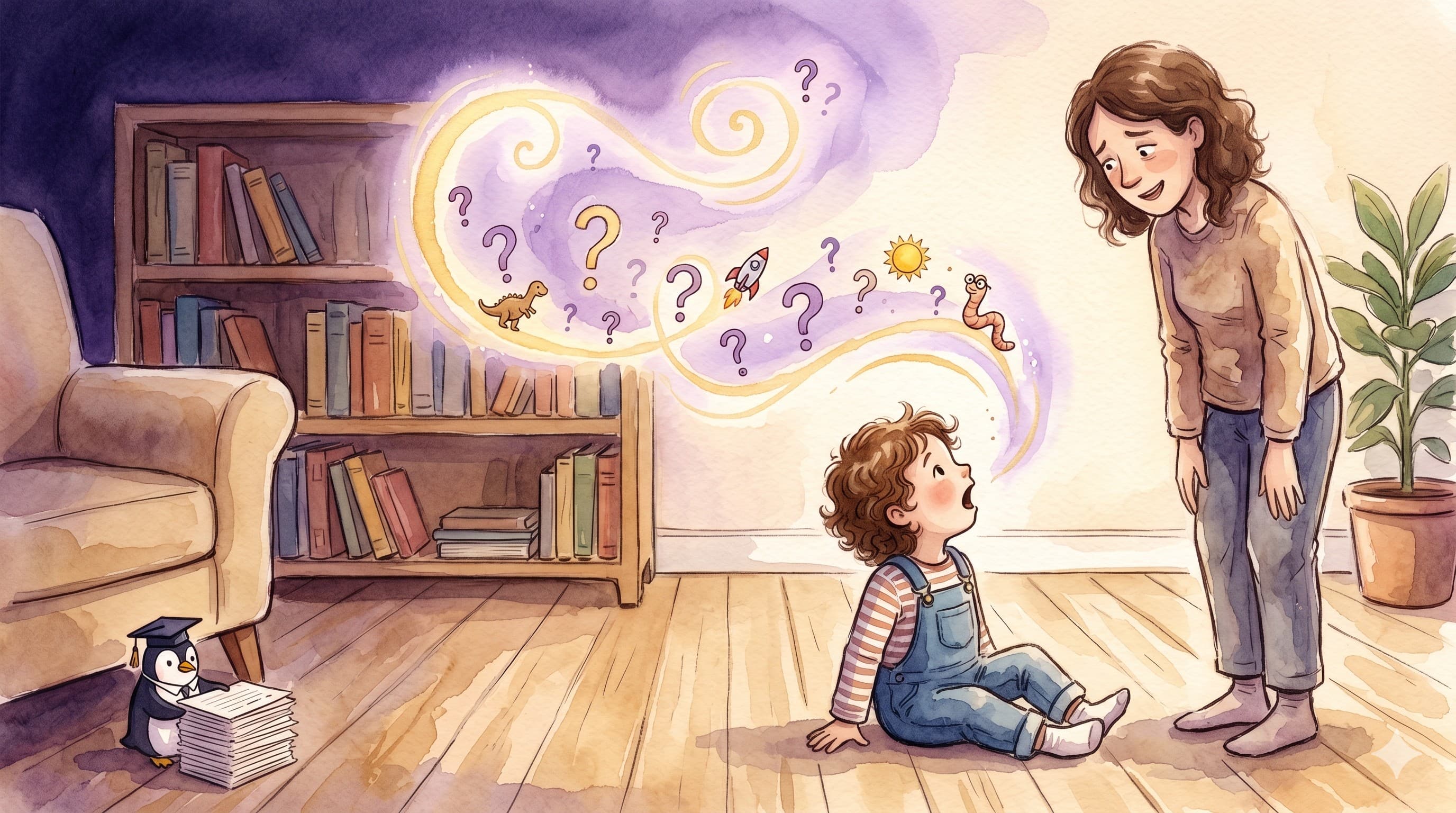
Mum… Dad… but WHY?
On the phase of experimenting on a living organism (the parent) - and on teleology.
A few statistics first, to set the scene (Chouinard, 2007):
- Three-year-olds ask an average of 76 questions per hour of adult conversation. (Yes. Per hour.)
- Between 30 and 42 months, the number of questions climbs from around 40–50 to 70–80 per hour.
- If a grown-up's answer doesn't satisfy them, children repeat or rephrase the question in 60–75% of cases - until they get what they need.
Where does it all come from?
When your child starts asking questions, it's the visible, admirable sign of something enormous happening inside their mind. They've stopped being a passive receiver of whatever the world offers them. They've become Someone: an explorer, a scientist, an experimenter, a fact-checker.
Think of a raft, gently carried along by a flood of incoming information - now suddenly fitted with an engine, turning itself around and making waves of its own.
How questions change - a quick timeline
- Ages 2–3: "What?" and "Where?" - learning names and places. Still relatively peaceful.
- Ages 3–4: "Who?" and "When?" - people start to matter. Context starts to expand.
- Ages 4–5: The Why Phase. Peak curiosity. Causes and mechanisms. Children have figured out that grown-ups (parents, especially) hold knowledge - and that questions are the key to getting it out.
- Ages 5+: Abstract thinking arrives. Hypothetical situations. Complex emotions. Next stop: wanting to figure things out on their own. Independent thinking begins to grow.
How to support it
You don't need to know the answer to every single question. (Nobody does. Not even the internet, though it tries.) What matters is showing that looking for answers can be genuinely good fun. That curiosity is worth the effort - regardless of whether you reach a tidy conclusion - because sometimes the journey matters more than the destination. And almost always, the Company matters most of all.
A few things that help:
- Simple language. Real examples.
- Objects, books, pictures - bring things into the room.
- Bounce it back sometimes: "What do you think?" - not to test them, but to let them know their ideas count too.
And what about teleology?
Teleology in developmental psychology refers to children's tendency to explain things - objects, animals, phenomena - through their function or purpose. In other words: children aren't looking for "dry facts." They're building a coherent picture of the world where everything has its place and its reason.
If diggers and scissors and cars are all for something, then birds and pebbles and the wind must be for something too. A child sees the world as a collection of tools and creatures made for each other - or for people.
— Mum, what are parents for?
— …
— (The simplest answer:) To love their children.
Over time, as knowledge builds, this kind of thinking shifts. But the urge to find a purpose in things - the little teleologist inside - never fully disappears. Even in adults. (Especially in adults, actually.)
Reviewed by Katarzyna Babka, MA, psychologist, specialist in child and adolescent psychotherapy.
Source: Michelle M. Chouinard (2007): Children's Questions: A Mechanism for Cognitive Development