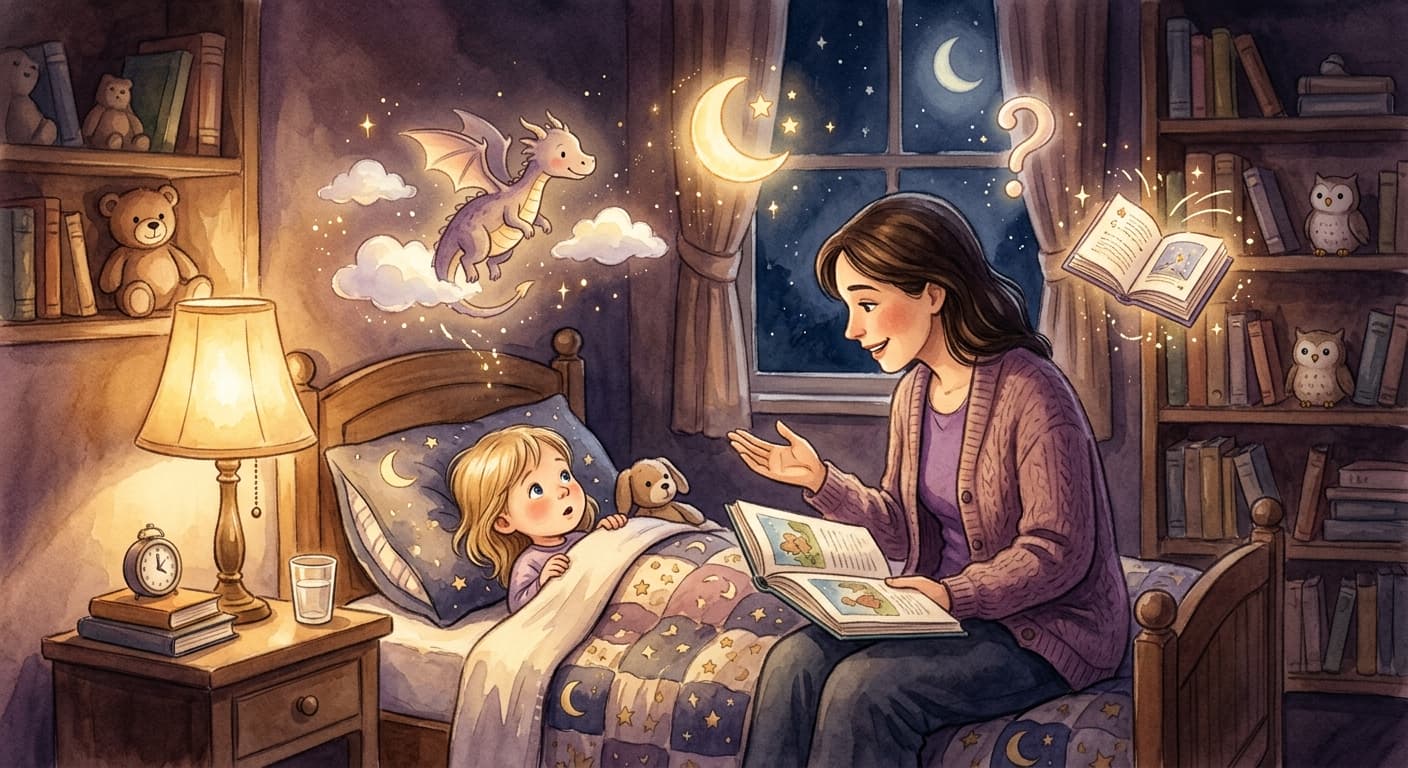
The Magic of Storytelling: How Your Words Build Worlds Inside a Child's Mind
Some moments are difficult to measure.
You can't schedule them. They never appear on a to-do list.
Like the moment when your child scoots a little closer and says:
"Tell me one more story."
It's not really a request for another bedtime tale.
It's an invitation.
And even though thousands of years have passed since stories were told around campfires (the campfires have mostly been replaced by sofas and very comfortable armchairs), our brains haven't changed much at all.
They still love stories.
Scientists are getting better at understanding why.
What Storytelling Actually Is
Storytelling is more than reading a book aloud.
The National Storytelling Network describes it as the art of sharing stories through words, voice, and gestures - while leaving space for the listener's imagination. A story doesn't exist in isolation. It happens between people. In a glance. In a pause. In the question:
"What do you think happened next?"
That's where the Magic happens.
Your Brain Doesn't Just Listen. It Joins In.
Psychologists have a wonderfully serious-sounding name for something many of us already know: narrative transportation.
It sounds very scientific.
But you've probably experienced it.
It's that moment when you stop hearing the vacuum cleaner in the next room. Your tea has gone cold (which tea insists on doing), and suddenly you're trying to cross the Old Forest with the hero. Or searching for the Philosopher's Stone. Which, unfortunately, might be stolen.
Your brain isn't listening from a safe distance anymore.
In a way, it's living the story.
Research shows that when we listen to a good story, the listener's brain activity begins to synchronise with the storyteller's. Scientists call this neural coupling. Mirror neurons help too. When a character runs, climbs a mountain, or feels afraid, a child's brain responds as if it's joining them on the adventure for a little while.
And that's why stories teach far more than new words.
(Although that part is fascinating too.)
A Tiny Laboratory of Feelings
Every story is a safe place to discover what courage tastes like. To wonder why people sometimes feel jealous. Or what happens after someone says, "I'm sorry."
Children watch what characters do.
They try to guess what might happen next.
And little by little, they discover that other people have thoughts, dreams, and feelings of their own.
Psychologists call this Theory of Mind.
It's the understanding that there's more than one way of seeing the world.
Meanwhile (almost by accident), the brain is busy doing a remarkable amount of work.
It remembers sequences. It practises concentration. It connects causes with consequences. It develops executive functions - working memory, flexible thinking, and the ability to pause before acting on impulse.
And emotions help memories stick.
The Thing Technology Can't Replace
Shared storytelling also creates something else.
Closeness.
Perhaps that's why stories have survived for thousands of years.
Not because we failed to invent something "more efficient."
We certainly did. Plenty of things.
But no invention has quite managed to replace the moment when someone says:
"Come here. Let me tell you something…"
…and the world around you changes.
Sometimes ten minutes before bed is enough. A few sentences. One hero. One adventure.
The rest will be happily handled by imagination.
(It loves jobs like that.)
How Naniby Uses This Magic
Naniby's story also began with a story.
There was laughter. There was creativity. There was a lot of enthusiastic pretending.
And then, after the fun, a rather serious question appeared:
What if the digital world had room for stories that truly belong to children?
We didn't want to tell stories for them.
And we still don't.
We want to create a place where children tell stories of their own. Our role is a little bit of suggesting. A little bit of helping to find the right word. And then stepping back - quietly, so as not to startle anything - to see what they make.
Because at Naniby, we believe technology doesn't always need to speak the loudest. Sometimes it just needs to listen. (Ours is quite good at that.)
And if, because of that, a child finds the courage to tell their own story - even one about a dragon who was afraid of the dark, or a banana whose feelings were deeply hurt when somebody stepped on his toe - then everything is working exactly as it should.
Written by Katarzyna Babka, MA, psychologist, specialist in child and adolescent psychotherapy.