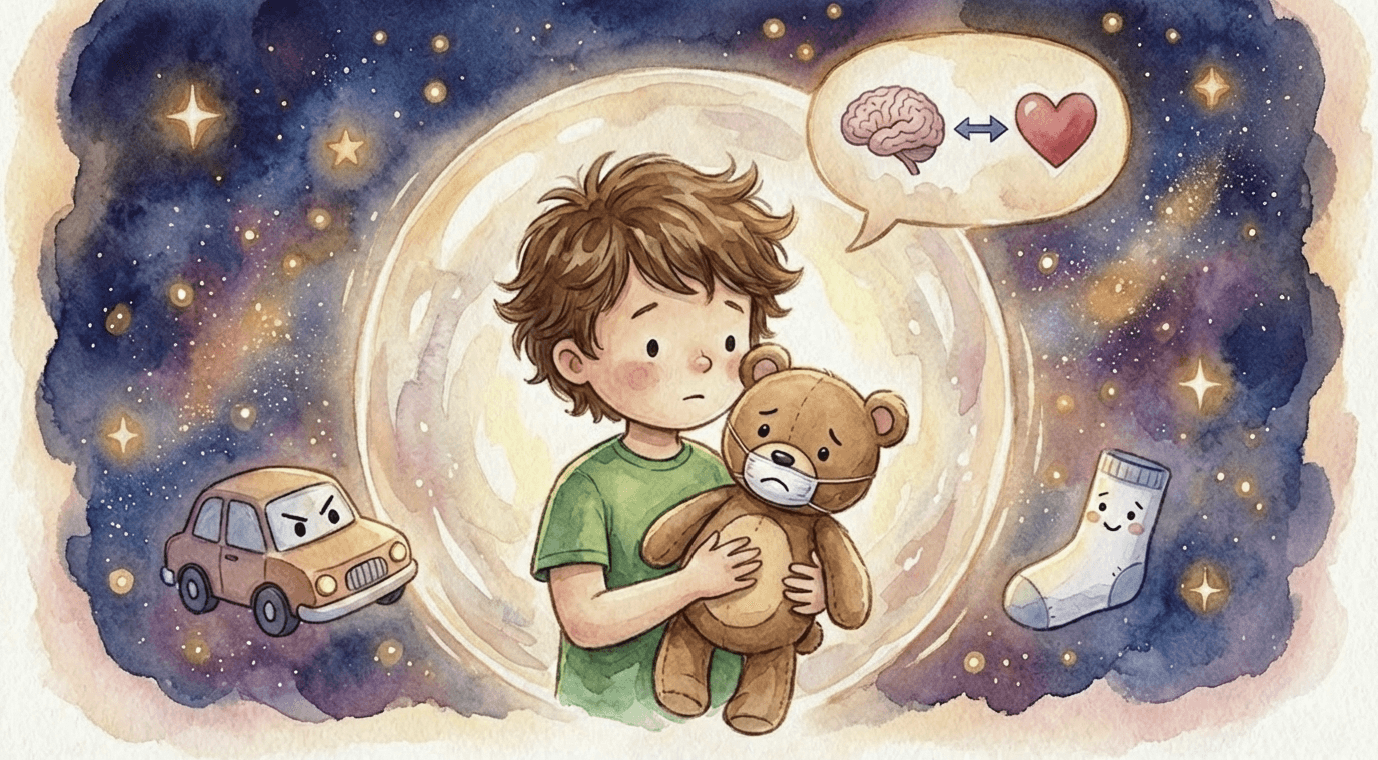
Here is something that may be happening in your house right now. The teddy bear is "sad." The car is "angry." The banana doesn't want to go to nursery. You've seen this. A hundred times. Maybe a thousand. It probably made you smile - because bananas, strictly speaking, don't have feelings. The banana, however, had other ideas.
Here’s the Secret
The banana might be right.
Or more precisely - the banana might be doing Something Very Important..
A three-year-old doesn't always walk up to a parent and say: "I'm scared about nursery." Sometimes they don't have those words yet. Sometimes they don't have that kind of self-awareness yet. They can barely get their socks on the right feet.
But they can say: "The bear doesn't want to go."
And that's not random. That's a brilliant little brain doing its job.
By pouring their feelings into the bear - or the car, or the banana - your child is building a small distance. A safe gap. Just enough room to look at That Feeling without it becoming too much. They stay in charge of the story. They can make the character be scared without admitting to the fear themselves. They can try out being brave. They can look for other options.
A three-year-old, regulating their emotions. On the kitchen floor. With a piece of fruit.
Wait. It Gets Better.
Developmental psychologists have been watching children do exactly this for nearly a hundred years. It started with the foundational work of Vygotsky and Piaget - but what caught our attention happened in the early 1990s at the University of Wisconsin-Madison. A team led by Inge Bretherton created the MacArthur Story Stem Battery: a tool that turned observation into practice.
The method is simple. A child is given the start of a story. Then the adult stops - at a Very Interesting Moment - and asks: "What happens next?"
And here's what happens.
Children pour their feelings into the ending. Every time.
A research review out of UCLA — led by educational psychologists Katherine Kelly and Alison Bailey - covered three decades and over two hundred studies. The conclusion: when children tell a story through a character, they show you what they actually think and feel. Things that are often too big, or too tender, to say out loud.
And as they get older? Researchers in Romania, studying children aged 6 to 11, found that children don't just accept that characters are "bad." In play, they reveal guilt. Shame. Making things right. The character says sorry — and then worries whether the sorry was good enough.
That's not just play anymore. That's practising how to be a person.
What You Can Do
Listen carefully. Play along. Ask the banana how long it's been feeling that way. Ask what might help the bear feel better about nursery. Don't correct it. Follow the story. You're not wasting time. You're watching - and supporting - the best emotional processing tool your child has.
Next time the banana has feelings, pay attention. Your child might be telling you Something Very Important - just not yet in their own voice.
How Naniby Uses This
Every story in Naniby starts with a character your child creates. A banana in a cape. A stressed little cloud. A dinosaur afraid of its own shadow. That character becomes the vessel for whatever your child needs to explore today. The AI doesn't correct. It follows the child. If clouds are made of mashed potato, we'll simply ask about the texture.
Reviewed by Katarzyna Babka, MA, psychologist, specialist in child and adolescent psychotherapy.