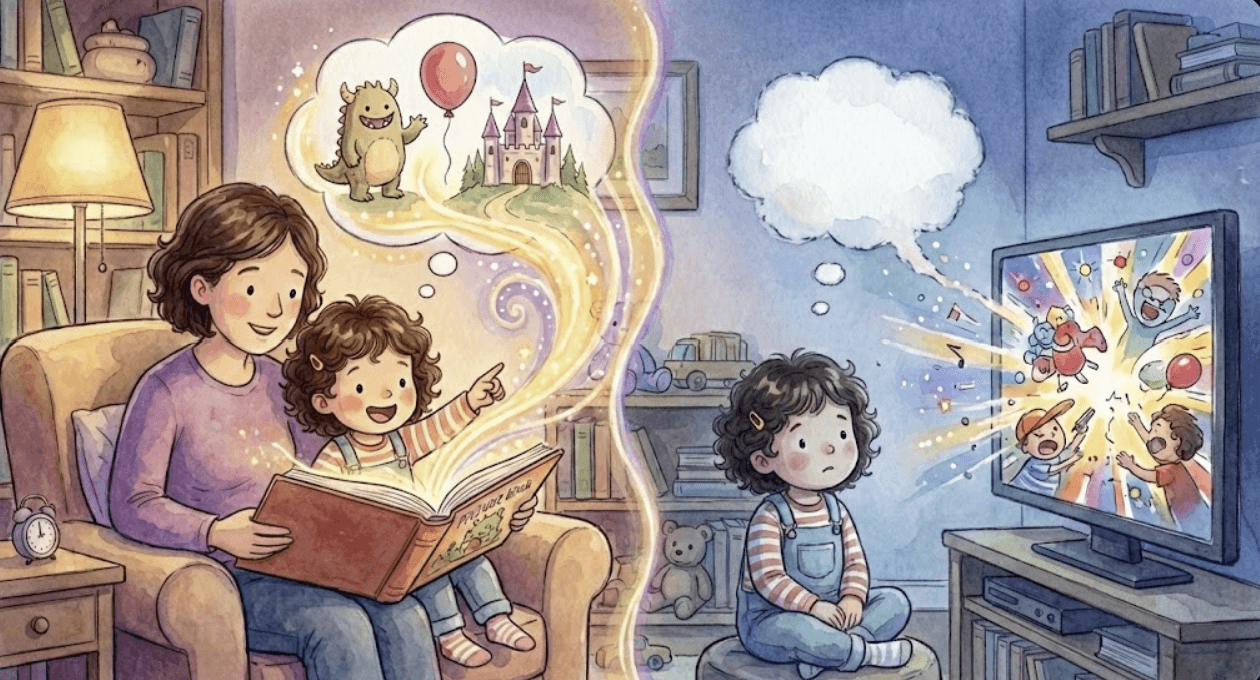
Your child can retell a picture book from last Tuesday in vivid, enthusiastic, occasionally fictional detail.
But they can't remember what they watched on the tablet an hour ago.
Strange, right?
Some scientists at Cincinnati Children's Hospital in Ohio got curious too. So they decided to look inside.
The Experiment
They put 3-to-5-year-olds in a brain scanner - which, if you've ever met a 3-year-old, is already impressive - and showed them the same story three ways. Just the audio. An illustrated book. A fully animated cartoon.
Then they looked at what the brain was doing. And measured how much the children actually understood.
And do you know what happened?
The cartoon lost.
The most colourful, most exciting, most everything version? About 50% comprehension.
The illustrated book and the audio? 70–81%.
The flashiest one came last. The quiet one won.
Here's Why
When a child looks at a still picture, their brain has to do the work. It fills in the movement. It imagines the sounds. It builds the bits between the pages. The Imagination Department lights up. The Language Department lights up. They start talking to each other.
When they watch a cartoon? The cartoon has already done all of that. So the brain… sits down. Puts its feet up. Has a little rest.
It's the difference between cooking and ordering takeaway. Both end in food. Only one teaches you anything.
Picture books make their brain exercise. Cartoons let it sit on the couch. And it turns out the brain does not thrive on the couch.
So Does This Mean Screens Are Bad?
No. That's the old conversation. The new one is much more interesting.
What matters isn't the screen. It's what's happening behind it. When a child is directing, deciding, creating - that's different. A narrative review by Croatian developmental researchers confirmed that structured, interactive tools actually boost creativity and problem-solving. Same screen. Completely different brain.
So the question isn't "screen or no screen."
It's: who's doing the imagining?
What You Can Do
Keep reading picture books. They're a brain workout disguised as a cuddle. Pause on the pages. Ask what happens next. And audio stories? Remarkably powerful. The child imagines everything. Rather like a cat - doing a tremendous amount of work while looking like it's doing absolutely nothing.
How Naniby Uses This
Naniby uses still pictures and voice. Not animation. When a new scene appears, it's an image - and the narration fills in the world through words. Your child's brain does the rest. We considered animation. We read the research. We chose the picture book. That's not a limitation. That's a Very Deliberate Choice.
The Research
- Children and Media: Tips for Parents
American Academy of Pediatrics guidelines for healthy media use.
- Digital Play and Child Development
Research on balancing digital and physical play experiences.