Creativity is not about art.
That's the first thing. Creativity is not painting. It's not drawing. It's not making things look pretty. Those are lovely. But creativity is something bigger.
Creativity is the ability to look at a problem and see more than one way through it.
And it starts with play.
Divergent Thinking
In the 1960s, psychologist J.P. Guilford at the University of Southern California identified a type of thinking he called divergent thinking — the ability to generate multiple solutions to a single problem. It's the opposite of finding the Right Answer. It's about finding ten interesting answers and then choosing.
Decades later, creativity researcher Mark Runco at the University of Georgia confirmed that divergent thinking in childhood predicts creative achievement in adulthood. The children who find unusual uses for a paperclip become the adults who find unusual solutions to problems nobody has solved yet.
And do you know where divergent thinking develops best?
In play. Specifically, in open-ended, unstructured play where there is no instruction manual and no predetermined outcome.
The Open-Ended Materials Advantage
Researchers at the University of Cambridge's Faculty of Education found that simple, open-ended materials — blocks, fabric, cardboard, natural objects — foster significantly more creative thinking than toys with a single predetermined use. A block can be a house, a phone, a spaceship, or a piece of cake. A toy that's already a phone is… a phone.
The magic isn't in the material. It's in the gap between what the material is and what the child decides it could be. That gap is where creativity lives.
Risk, Failure, and Resilience
Creative play also teaches something that structured activities can't: how to fail. When the tower falls, the child rebuilds. When the story takes a wrong turn, they redirect. When the dragon doesn't cooperate, they negotiate. (Or they send a bigger dragon. Also valid.)
Angela Duckworth's research on grit at the University of Pennsylvania found that persistence through difficulty — the willingness to keep going when something isn't working — predicts success more reliably than talent. And that persistence is practised, over and over, in play.
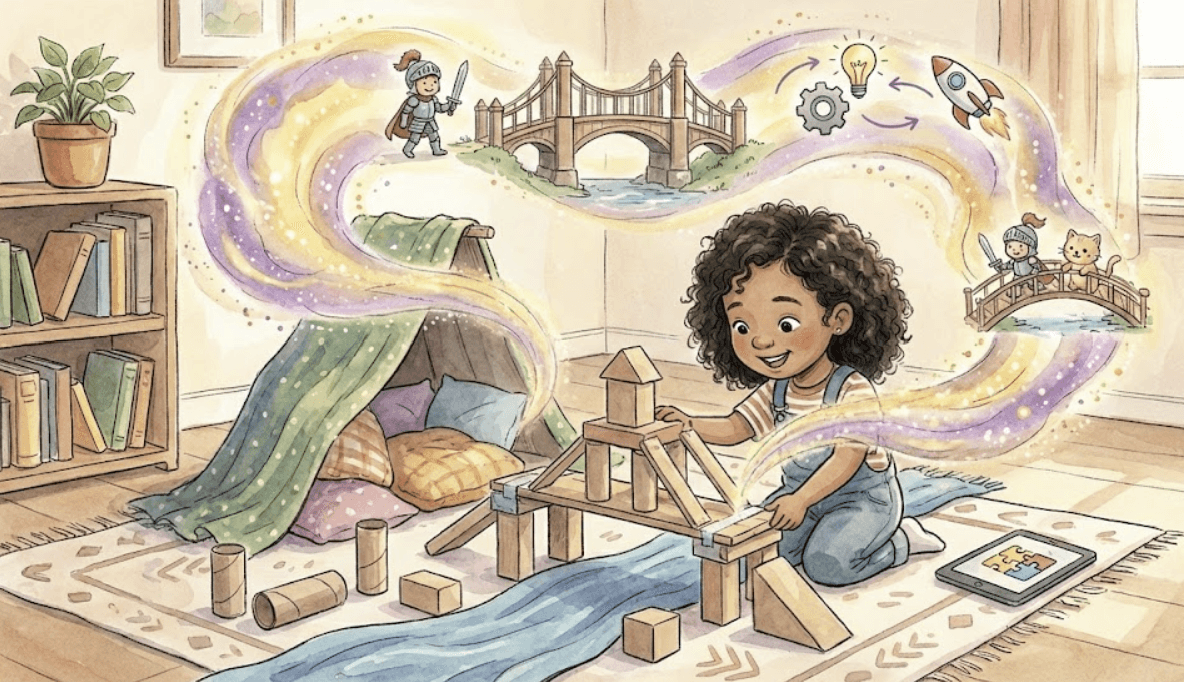
A child building a house out of cushions is practising the same cognitive process as an engineer solving a structural problem. They're just using softer materials.
How Naniby Uses This
In Naniby, there are no right answers and no predetermined plots. Your child's story can go anywhere. The dragon can be friendly. The castle can be made of cheese. The ending can be "everyone had a nap." This open-endedness is deliberate: it's the same creative space that blocks and cardboard provide, just inside a narrative. Divergent thinking, practised one story at a time.
The Research
- Spatial Reasoning and STEM Success
Research linking spatial skills to STEM achievement.
- Hands-On Learning and Brain Development
National Association for the Education of Young Children on hands-on learning.