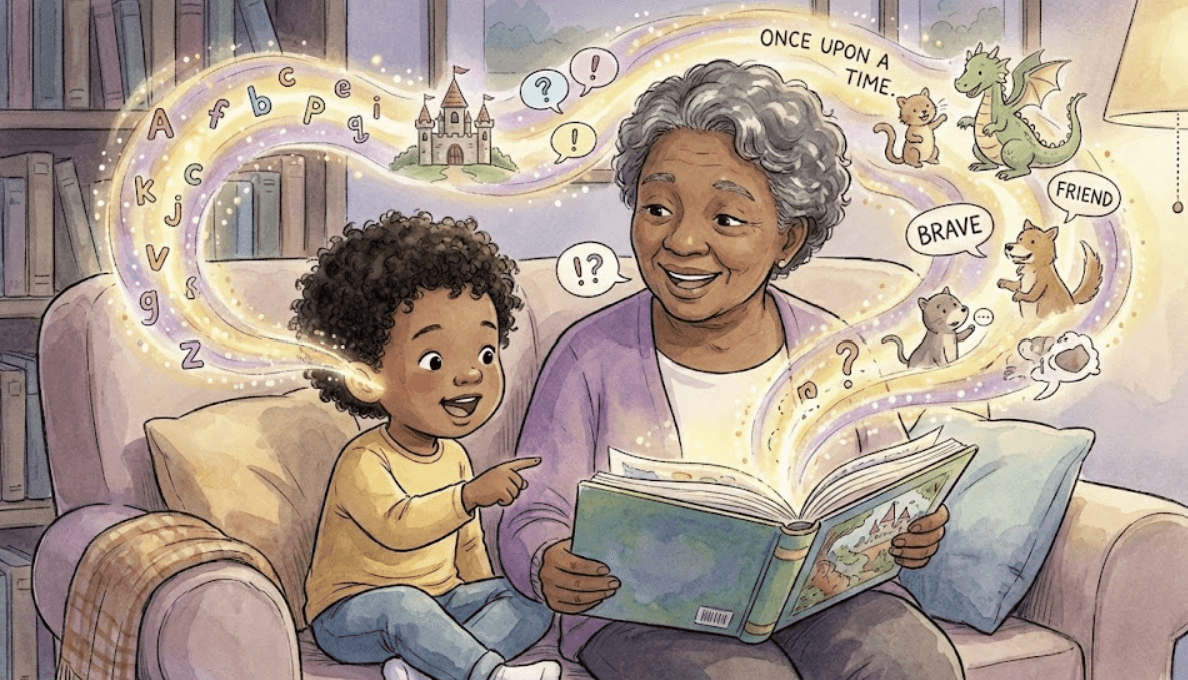
Children learn words in two ways.
The first way is conversation. Everyday talk. "Pass the milk." "Put your shoes on." "Please stop putting the cat in the shopping bag."
The second way is stories.
And stories do something conversation can't. They introduce words a child would never hear at the breakfast table. Words like "enormous" and "trembling" and "journey." Words that live inside adventures, not inside instructions.
The Vocabulary Gap
Researchers at the University of Kansas - Betty Hart and Todd Risley, in what became one of the most cited studies in developmental linguistics - found that the number of words a child hears in the first three years of life predicts their vocabulary, reading ability, and academic performance years later. Stories are one of the most efficient ways to fill that gap, because they expose children to richer, more varied language than everyday conversation.
From Listening to Speaking
When children hear stories, they don't just collect words. They absorb sentence structures. Narrative patterns. The rhythm of how a story begins, builds, and resolves. Developmental linguists at Harvard's Graduate School of Education found that children who are regularly read to internalise these patterns and use them when they start telling their own stories - and eventually, when they start writing.
A child who hears "Once upon a time" enough times will eventually say it themselves. And that's not imitation. That's the brain building a template for narrative.
But Here's the Really Interesting Part
Passive listening is good. But interactive storytelling - where children answer questions, predict what happens next, and retell stories in their own words - is dramatically more powerful.
Research from the National Institute for Literacy found that children who engage in dialogic reading - where the adult asks open questions and the child becomes a co-teller - show accelerated vocabulary growth compared to children who simply listen.
When a child predicts what happens next, they're not guessing. They're using every language tool they have: vocabulary, grammar, narrative logic, and emotional understanding. All at once. All in a sentence.
And for Multilingual Families
Storytelling is especially powerful for bilingual children. Research from the University of Toronto's Ontario Institute for Studies in Education found that stories help children maintain heritage languages while building fluency in the dominant language - creating stronger cognitive flexibility overall. The story doesn't care which language it's told in. It builds brains in all of them.
Every story your child hears is a vocabulary lesson, a grammar lesson, and an empathy lesson disguised as an adventure. The purple dinosaur eating spaghetti for breakfast is doing more than you think.
How Naniby Uses This
Naniby is interactive storytelling by design. Your child doesn't just listen - they direct. Every question the AI asks is an open question that invites them to use their words, build their sentences, and stretch their vocabulary. And because the story follows their ideas, they hear their own words reflected back in richer, more complex language. It's dialogic reading with an AI that never runs out of stories.
The Research
- Social Emotional Learning and Play
Collaborative for Academic, Social, and Emotional Learning's research foundation.
- The Role of Play in Social Development
Research on how play shapes social competence and emotional skills.